Decorators in Saltaire & Shipley
Decorating a house in Saltaire is not quite the same as decorating anywhere else. The village is a Conservation Area and a UNESCO World Heritage Site. The terraces are 170 years old. The stone breathes, the plaster moves, and the colours you can use on the outside are not entirely up to you. This page covers what you actually need to know before hiring a decorator — or picking up a brush yourself.
Conservation area restrictions — what you can and can’t paint
If your property is in the Saltaire Conservation Area — which covers the original village grid, roughly Victoria Road to Albert Terrace and beyond — exterior alterations are controlled. That includes paint colour. You cannot repaint your front door bright red, render over the stonework, or use high-gloss masonry paint on walls that were designed to be left as bare stone.
For window frames, doors, and rainwater goods, Bradford Council expects colours that are consistent with the Victorian character of the village. In practice, that means muted heritage shades: off-whites, sage greens, dark blues, stone greys, and black for ironwork. If you want something different, you can apply to the Conservation Officer, but approvals for anything bold on a front elevation are rare.
Rear elevations and interiors are your own business. Inside, you can do what you like. But on any surface visible from the street, treat the Conservation Area designation as a genuine constraint, not a suggestion.
“You can do what you like inside. But on anything visible from the street, conservation rules are a genuine constraint, not a suggestion.”
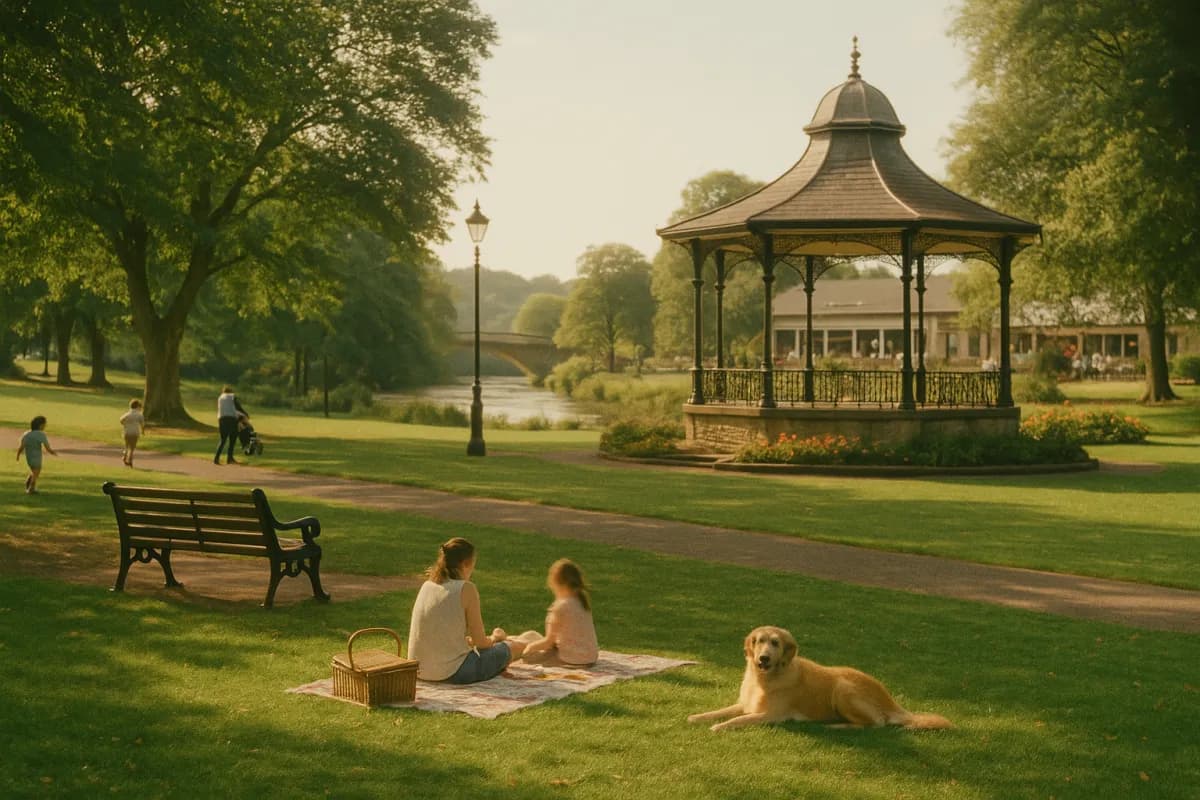
Original Saltaire terraces — bare stone frontages with painted joinery in heritage-appropriate colours. Conservation rules keep it that way.
Heritage-appropriate vs restricted — a quick reference
This is not an exhaustive list, and individual properties may have specific conditions attached. But as a general guide for the Saltaire Conservation Area, these are the typical boundaries.
Generally acceptable
- Off-white, cream, or stone for window frames
- Dark green, navy, or black for front doors
- Black or dark grey for rainwater goods
- Limewash on stone that was historically limewashed
- Breathable mineral paints on rendered sections
- Heritage colour ranges (Farrow & Ball, Little Greene, Dulux Heritage)
Typically restricted or refused
- Bright or saturated colours on front elevations
- Non-breathable masonry paint on bare stone
- Rendering or cladding over original stonework
- High-gloss finishes on exterior surfaces
- uPVC-style white on Victorian timber frames
- Spray-painting exterior stone (traps moisture)
When in doubt, contact Bradford Council’s Conservation team before work starts. It is considerably easier to get approval in advance than to be asked to undo a finished job.
Decorating costs in the Saltaire area
Decorating prices depend heavily on prep work, which is where period properties get expensive. A room with smooth plasterboard walls takes half the time of one with 170-year-old lime plaster and picture rails. These are realistic local ranges.
- Single room (walls & ceiling)
- £150–£350Standard prep, modern plaster
- Single room (period property)
- £250–£500Plaster repair, coving, rails
- Wallpapering (per room)
- £200–£450Paste-the-wall or paste-the-paper
- Exterior painting (3-bed terrace)
- £800–£2,000Scaffolding may be extra
- Front door & frames
- £100–£200Sand, prime, two coats
- Full house interior (3-bed)
- £2,000–£5,000Depends entirely on condition
- Lead paint removal (per room)
- £300–£600Specialist containment needed
- Limewash application
- £15–£25/m²Multiple coats, breathable finish
£250–£500
Per room in a period Saltaire terrace, once you account for plaster repair, filling cracks around picture rails, and extra coats on uneven surfaces. That is roughly double what the same size room costs in a new build. Prep work is the difference.
Decorating problems specific to old stone houses
Saltaire’s terraces were built with lime mortar and lime plaster on solid stone walls. No cavity. No damp-proof course (or one that was added later and may have failed). No plasterboard. This changes how paint and paper behave, and a decorator who only works on modern homes may not understand why.
Limewash vs modern masonry paint
Lime plaster and stone need to breathe. Moisture passes through the wall and evaporates from the surface — that is how solid-wall buildings manage damp. Modern masonry paint (vinyl, acrylic, silicone) creates a film that blocks this evaporation. The moisture gets trapped behind the paint, the plaster stays wet, and eventually it blows. You get bubbling, flaking, and damp patches that were not there before.
Limewash is the traditional finish for stone that was originally limewashed. It lets moisture through. It weathers gracefully rather than peeling. It needs reapplying every few years, which is a feature, not a flaw — each coat bonds to the last and builds depth. Modern breathable mineral paints (silicate paints) are an alternative with better durability, but they are more expensive.
Prep work on 170-year-old plaster
Old lime plaster is softer than modern gypsum plaster. It has a different texture, it moves with the building, and it develops hairline cracks that are normal and usually cosmetic. A decorator who skim-coats the entire wall with gypsum to “get it smooth” is creating a hard layer over a soft one. It will crack and delaminate over time. The correct approach is to patch with lime-based plaster, fill cracks with flexible filler, and accept that a 170-year-old wall will never look like a new-build partition.
Lead paint in pre-1960 layers
Lead-based paint was standard in the UK until the 1960s and was not fully banned for domestic use until 1992. In a house built in the 1850s, there may be multiple layers of lead paint under more recent coats. This is not a problem if the surface is stable and you’re painting over it. It becomes a problem when you sand, scrape, or strip — especially in rooms where children or pregnant women spend time.
Professional lead paint removal involves containment sheeting, HEPA-filtered extraction, and careful disposal. It is not a scrape-and-sand job. If a decorator does not mention lead when quoting to strip old paintwork in a Victorian house, they may not be thinking about it. Ask.
Wallpapering in period properties
Wallpapering a Saltaire terrace is harder than it looks. The walls are rarely plumb or flat. Picture rails, dado rails, and cornicing break up the surfaces. Here is what to expect.
- Uneven walls
- Old lime plaster has gentle undulations. Thin papers show every bump. Heavier papers or lining paper first will give a better finish.
- Picture rails & dado rails
- Cutting in around period mouldings takes time. Budget for longer labour hours than a modern square room.
- Damp patches
- Do not paper over damp. The adhesive will fail and mould will grow behind the paper. Fix the damp first, let the wall dry fully, then paper.
- Paste-the-wall
- Modern paste-the-wall papers are easier to hang on uneven surfaces and can be repositioned. Worth considering for difficult rooms.
Victorian colour palettes
The Victorians used deeper, richer colours than we often assume. Original Saltaire interiors would have had:
- Deep reds and burgundies in parlours
- Dark greens and teals in dining rooms
- Ochre and warm stone tones in hallways
- Lighter blues and greys in bedrooms
- White or off-white ceilings throughout
Little Greene’s Victorian palette and Farrow & Ball’s archive colours are both good starting points if you want period-appropriate interiors. Nobody is going to enforce these — they are just historically honest choices.
Saltaire Guide · Consult
1 / 10
What’s happening?
Pick the closest one — we’ll shape everything else around it. You can change your mind later.
Checking a decorator before they start
Painting and decorating is an unregulated trade. There is no compulsory registration, no licensing, and no formal qualification required. That means your own checks matter.
- 1
Ask about experience with period properties.
A decorator who mostly works on new builds may not understand lime plaster, lead paint, or conservation restrictions. Ask specifically about Victorian or pre-1900 houses. If they look blank, they are not the right fit for a Saltaire terrace.
- 2
Get a written quote with prep work itemised.
Prep is where decorating costs add up. The quote should separate out plaster repairs, sanding, priming, and paint coats. If it just says "decorate lounge — £300", you have no idea what is included and no recourse when corners are cut.
- 3
Ask what paint they will use on exterior stone.
If they suggest standard masonry paint for bare stone on a Victorian terrace, that is a warning sign. Breathable finishes (limewash, silicate paint, mineral paint) are what you need. A decorator who understands old buildings will know this without prompting.
- 4
Check their approach to lead paint.
If you are stripping old paintwork in a pre-1960 property, lead is a realistic risk. Ask how they handle it. The answer should involve testing, containment, and proper disposal — not "we just sand it off." HSE guidance on lead paint in domestic properties is clear.
- 5
Look at photos of previous period property work.
Any decorator worth hiring for heritage work will have photos. Look at cutting-in around cornicing, the finish on uneven walls, and how they have handled colour transitions at dado or picture rail height. The details tell you more than any testimonial.

Our accountability register
Decorating disputes are common because the work is visible and subjective. What counts as a “good finish” varies. But some things are objective: paint drips on carpet, plaster cracked within weeks, prep skipped entirely, wrong colour applied without checking.
If you have had decorating work done in the Saltaire or Shipley area — through us or otherwise — and it fell materially short of what was agreed (skipped prep, wrong materials on heritage surfaces, lead paint disturbed unsafely, Conservation Area rules ignored), you can report it to us. We investigate patterns. If the same decorator generates repeated independent complaints with the same issues, we will publish a factual summary. The decorator is always given the chance to respond before publication.
For serious issues — particularly unsafe lead paint removal or unauthorized changes in the Conservation Area — also contact Bradford Trading Standards and, if applicable, the Conservation Officer.
Common questions
Real questions from Saltaire residents. If yours isn’t here, ask us.
Do I need planning permission to repaint my house in Saltaire?
For the exterior, it depends. If you are repainting joinery (doors, window frames, gutters) in the same colour or a heritage-appropriate alternative, you generally do not. If you want to change to something noticeably different, or paint bare stone that was not previously painted, you should check with Bradford Council's Conservation team first. Interior decoration requires no permissions at all.
Can I use Farrow & Ball or similar paints on a Victorian house?
Yes, and they are a good choice for interiors. Both Farrow & Ball and Little Greene produce heritage ranges with colours based on Victorian originals. For exterior stone, the key factor is breathability — Farrow & Ball's exterior masonry paint is breathable, but limewash or silicate paint is better for bare stone on a solid-wall property.
How do I know if my paintwork contains lead?
If your house was built before 1960 and has original or early paintwork layers, lead is a realistic possibility. You can buy lead paint test swabs (3M LeadCheck or similar) for about £15. Alternatively, a decorator experienced with period properties will test before stripping. The main risk is during sanding or scraping — undisturbed lead paint under modern layers is generally safe to leave.
Should I use limewash or modern paint on exterior stone?
If the stone was historically limewashed (you will see traces of white in the texture), limewash is the most appropriate finish. It is breathable, historically accurate, and builds character over time. It needs reapplying every 3-5 years. If you want something more durable, silicate mineral paint is breathable and lasts longer. Never use standard vinyl or acrylic masonry paint on old stone — it traps moisture and causes damage.
Why is decorating a Victorian house more expensive than a modern one?
Prep work. Old lime plaster needs patching with compatible materials. Walls are rarely flat or plumb. Picture rails, dado rails, and cornicing all require careful cutting-in. Sanding old paintwork may require lead precautions. Window frames are often detailed timber, not flat uPVC. A 3-bed Victorian terrace typically takes 50-100% longer to decorate than a modern house of the same size.
Can I wallpaper over old lime plaster?
Yes, but with preparation. The surface needs to be stable — knock off any loose or blown plaster first. Lining paper is strongly recommended as a base layer, especially with patterned papers, because it smooths out the gentle undulations in old plaster. Use a breathable adhesive if possible, and avoid vinyl-coated papers in rooms prone to condensation (kitchens, bathrooms) — they can trap moisture against the old plaster.
How long should exterior paintwork last in Saltaire?
Good exterior paint on properly prepared timber should last 5-8 years before needing a maintenance coat. Limewash on stone needs refreshing every 3-5 years. The Aire Valley gets plenty of rain and the stone terraces face prevailing westerly weather, so exterior finishes work harder here than in more sheltered locations. Cutting corners on prep or paint quality shows up faster.
Other local services
Honest guides for every trade. Same editorial approach, same accountability.