1853 · Saltaire, BD18
History of Saltaire.
A model industrial village founded by Sir Titus Salt. Italianate stone streets, a colossal mill and a riverside park — together recognised by UNESCO in 2001 for outstanding universal value. This page is the overview, with links out to the buildings, people, timeline and research underneath.
Topics
Pick a way in.
Every history topic on the site, grouped four ways. Browse, or go straight to what you came for.
Overview & timeline
Buildings & places
- Buildings & architecture
How the village was planned, built and laid out – mills, streets and civic set pieces.
- Church (URC)
Landmark tower, portico and Salt family mausoleum.
- Almshouses & model housing
Philanthropic housing and care on Victoria Road.
- School & education
Classrooms, ventilation and the investment in skills.
- UNESCO World Heritage
Criteria, boundaries and what inscription means in practice.
People & stories
UNESCO
Why it was inscribed.
Outstanding universal value
Saltaire is a remarkably complete planned industrial village — a monumental mill set alongside dignified workers' housing, civic buildings and recreation spaces, all conceived as one design.
It demonstrates 19th-century approaches to industry, welfare and town planning that influenced developments well beyond Yorkshire.
Integrity and authenticity
The original street plan, skyline and stone façades largely survive. Adaptive reuse of the Mill and conservation of Roberts Park protect the vistas and the relationship between river, canal and village.
Timeline
From mill opening to today.
The essentials so you can place what you see on the ground. For the deeper version, see the dedicated timeline page.
- 1853
Salts Mill opens
Sir Titus Salt builds a vast new alpaca-wool mill on the River Aire and Leeds–Liverpool Canal, away from polluted Bradford.
- 1853–1876
Model village constructed
Italianate stone housing, neat streets, schools, church, wash-houses and recreational facilities provided for workers.
- 1876
Titus Salt dies
Leadership passes to his sons and trustees; the village identity and amenities continue to shape daily life.
- 20th c.
Industry changes
Wool trade fluctuates; the mill passes through different owners. The village’s fabric remains largely intact.
- 1987
Regeneration begins
New uses for the Mill and village accelerate conservation, cultural activity and public access.
- 2001
UNESCO inscription
Saltaire is designated a World Heritage Site for its outstanding, intact example of a mid-19th-century industrial model village.
- Today
Living village & culture
Galleries, bookshops and cafés in the Mill; Roberts Park restored; the village remains a thriving residential community.
Architecture
Planned as one design.
A quick sketch of the setting. For a full building-by-building tour, see the architecture guide.
Italianate style in Yorkshire stone
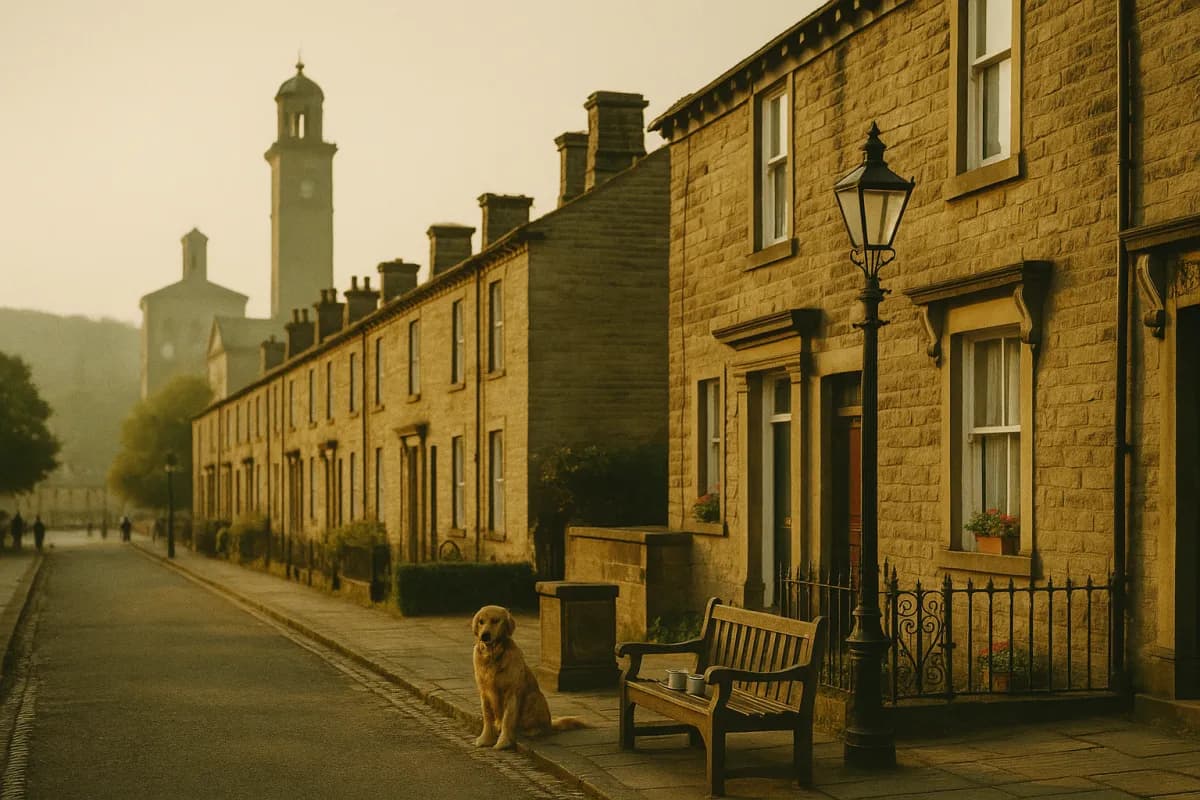
Mill and housing draw on Italian Renaissance forms: round-arched windows, cornices, symmetry and a landmark chimney.
Planned urban layout
Gridded streets with consistent stone façades, crescents and civic buildings create coherence rare in industrial towns.
Social infrastructure
Church, schools, institute, wash-houses and recreation spaces reflect 19th-century philanthropy and reformist ideals.
Setting by water & rail
Sited by the River Aire, the canal and the railway for power and transport, yet separate from Bradford’s smoke.
People
Behind the village.
The names you'll see most often. See also the Titus Salt biography and the reading list.
Sir Titus Salt (1803–1876)
Industrialist and philanthropist who consolidated his mills at Saltaire and built housing and amenities for workers.
James Roberts (1848–1935)
Later owner associated with village improvements; Roberts Park bears his name after a key donation.
Architects & planners
Village built to unified plans by professional architects/engineers of the period, producing rare consistency across streets.
A living community
Saltaire is not a museum. Residents live in the historic houses — please be considerate when exploring and keep to public routes.
Preservation
Kept, not frozen.
- 01
The village retains exceptional integrity: plan, building stock and skyline survive with limited alteration.
- 02
Adaptive reuse of Salts Mill preserves the industrial shell while supporting culture and retail.
- 03
Roberts Park restoration maintains vistas between park, river, canal and Mill.
- 04
Ongoing conservation management balances residential life with visitor interest.
Sources
Primary references.
We prioritise authoritative sources. If you spot an error, email hello@saltaireguide.uk.
- UNESCO World Heritage Centre — Saltaire
- Historic England — listings & guidance
- Bradford Council — conservation & planning
- Salts Mill — official site & visitor info
- Saltaire History Club — local research
Historical details change as new research appears. Treat this page as a practical overview and follow the links above for deeper study.
Quick answers
The ones you'll ask.
Why did UNESCO list Saltaire?
It is an exceptionally intact model industrial village that shows how 19th-century ideas about industry, housing and welfare were built into one planned place.
When was Salts Mill built?
The Mill opened in 1853, with the surrounding village built largely between 1853 and 1876.
Is Saltaire still lived in?
Yes. It is a living community with residents, shops, cafés and cultural venues—please be considerate when visiting.
Where can I learn more on site?
Start at Salts Mill for galleries and shops, then walk to Roberts Park and through the village streets. Local signage and exhibitions change seasonally.
Next
Pair the history with a lap of the village. Salts Mill, Roberts Park and a towpath stretch on the Leeds–Liverpool Canal cover most of what you'll see. If you're visiting, start with Plan your visit and Parking.
Saltaire Guide · Published by Pacavita · Saltaire, BD18