
Cleaners in Saltaire & Shipley
Finding a good cleaner is straightforward. Finding one who turns up reliably, week after week, and does the job properly — that’s harder. This page covers what domestic cleaning actually costs in the Saltaire area, what you should expect for your money, and the practical details that make the difference between a good arrangement and a frustrating one.
Cleaning Saltaire’s stone-floored terraces
If you live in one of the original Saltaire terraces, your ground floor likely has Yorkshire stone flags — the same ones laid in the 1850s. These are beautiful, practical, and almost indestructible. But they do need different care from laminate or carpet.
The main issue is limescale. Saltaire sits in a hard water area — calcium carbonate builds up on stone surfaces, in grout lines, and around taps. A cleaner who’s used to working in soft water areas will use products that don’t touch it. You need someone who knows that a dilute acid-based cleaner (HG Limescale Remover or similar) is safe on sealed stone but will etch unsealed flagstone if left too long.
The other thing about these terraces: the rooms are smaller than modern builds. A 3-bed Saltaire terrace is typically 800–950 sq ft. That means a regular clean takes less time than you might expect — 2 to 2.5 hours for a thorough job. If a cleaner is quoting 4 hours for a standard terrace, either they’re slow or they’re padding the time.
“A 3-bed Saltaire terrace is typically 800–950 sq ft. A regular clean takes 2 to 2.5 hours. If someone quotes 4, ask why.”
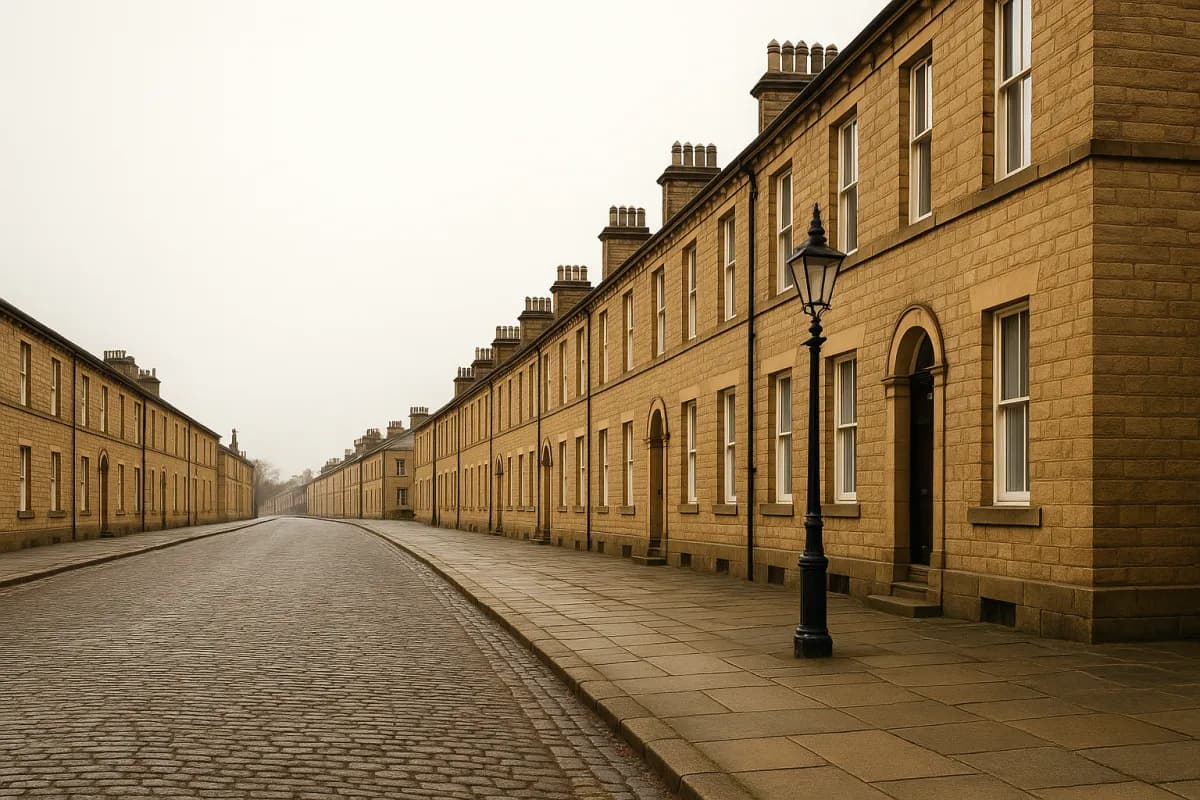
Saltaire’s terraces — stone flags, smaller rooms, and hard water that leaves limescale on everything.
What “deep clean” actually means
“Deep clean” is one of those terms that means whatever the person saying it wants it to mean. Here’s what it should include, room by room, and what typically costs extra.
Kitchen
All surfaces degreased, inside and outside of cupboard doors, behind and under appliances, splashback scrubbed, sink descaled, floor washed. Oven interior is usually extra (£30–£50).
Bathroom
All tiles and grout scrubbed, limescale removed from taps and shower screen, toilet deep-cleaned including behind and base, mirror cleaned, extractor fan wiped. Mould treatment on silicone is extra.
Bedrooms & living areas
All surfaces dusted including tops of wardrobes and door frames, skirting boards wiped, light switches cleaned, inside windows (ground floor). Inside windows upstairs and interior of wardrobes are usually extra.
Always agree exactly what’s included before the clean starts. A good cleaner will walk through the property with you and confirm the scope. No surprises on either side.
What cleaning costs in BD17/BD18
Real local rates. Cleaners in the Saltaire/Shipley area tend to charge less than Leeds city centre but more than further out in the Bradford district.
- Regular clean (hourly)
- £13–£18/hrMost common arrangement
- Regular clean (3-bed terrace)
- £30–£452–2.5 hours typical
- Deep clean (3-bed terrace)
- £120–£2004–6 hours
- End-of-tenancy clean (3-bed)
- £180–£300Deposit-standard
- Oven clean (add-on)
- £30–£50Specialist product needed
- Carpet clean (per room)
- £25–£40Hot water extraction
- One-off spring clean
- £100–£180Between regular and deep
Weekly
£30–£45
Keeps on top of things. Best value per visit.
Fortnightly
£35–£50
Most popular. Slightly more per visit — more to do.
Monthly
£45–£65
Closer to a light deep clean each time.
End-of-tenancy cleaning and your deposit
If you’re renting in Saltaire and your tenancy is ending, the cleaning standard required to get your deposit back is straightforward in theory: leave the property in the same condition you found it, minus fair wear and tear.
In practice, this is where most deposit disputes happen. Landlords and agents compare the check-out report against the check-in inventory. Limescale on the bathroom taps, grease behind the hob, dust on top of the kitchen cabinets — these are the things that get flagged. They’re not unreasonable deductions if the check-in report says those areas were clean.
A professional end-of-tenancy clean costs £180–£300 for a 3-bed Saltaire terrace. Most reputable cleaners offer a guarantee — if the agent flags issues within 48–72 hours, the cleaner goes back and fixes it at no charge. Ask about this before booking. It’s the single most important thing about an end-of-tenancy clean.
Finding a cleaner who actually turns up
Reliability is the number one complaint about domestic cleaners. Not the quality of the work — the cancellations, the lateness, the gradual shortening of sessions. The best way to find someone reliable is word of mouth. Ask neighbours on your street. The Saltaire community Facebook group gets these requests regularly, and the recommendations come from people who are actually using the cleaner, not review-farm profiles.
If you go through an agency, you’ll pay more (typically 30–40% premium) but you get a backup — if your cleaner is ill, the agency sends someone else. For a self-employed cleaner, there’s no backup. Both models work. It depends whether you value consistency of person or consistency of schedule.
Regular vs deep vs end-of-tenancy
Regular clean
Hoovering & mopping
Surfaces wiped
Bathroom cleaned
Kitchen surfaces
Bins emptied
Inside oven
Behind appliances
Inside windows
Skirting boards
Deep clean
Everything in regular
Skirting boards
Behind appliances
Inside cupboard fronts
Light switches
Inside oven (add-on)
Upstairs windows
End of tenancy
Everything in deep
Inside oven
All windows (inside)
Inside cupboards & drawers
Limescale removal
Carpet deep clean
External windows
Hard water tip
Saltaire’s water supply is hard — around 200–300 mg/l calcium carbonate. Limescale builds up fast on taps, shower heads, and around the base of toilets. White vinegar or a dilute citric acid solution works for light buildup. For heavy scale on chrome or porcelain, use a dedicated limescale remover — but never on unsealed natural stone.
Saltaire Guide · Consult
1 / 10
What’s happening?
Pick the closest one — we’ll shape everything else around it. You can change your mind later.
Setting things up properly from the start
Most problems with cleaners come from unclear expectations, not bad intentions. Sort these out at the beginning and you’ll avoid 90% of the issues.
- 1
Agree a task list, not just a time slot.
A 2-hour clean means different things to different people. Walk through the house together on the first visit and agree exactly what gets done. Write it down. Both keep a copy.
- 2
Discuss products and equipment upfront.
Some cleaners bring their own products and equipment. Some expect you to provide them. Neither is wrong, but you need to know which before they arrive. If you have stone floors or specific surfaces, mention it — the wrong product can cause damage.
- 3
Agree on key holding or access.
If you won't be home, how do they get in? A spare key, a key safe (about £25 fitted), or a smart lock code. Agree this in writing. If they have a key, agree that it stays with them and isn't copied.
- 4
Sort out cancellation terms.
What happens if you cancel? What happens if they cancel? 24-hour notice on both sides is reasonable. Less than that, the cancelled party should still be paid (or pay). Clear expectations prevent resentment.
- 5
Check insurance.
A self-employed cleaner should have public liability insurance. If they break something — a vase, a tap, your stone floor finish — insurance covers it. Without it, you're relying on goodwill. An agency cleaner is covered by the agency's policy.

Our accountability register
Domestic cleaning is a largely unregulated trade, which makes accountability harder. There’s no registration body to report to. But patterns of behaviour still matter.
If you’ve experienced genuine problems with a cleaner in the Saltaire/Shipley area — repeated no-shows without notice, damage to your property, items going missing, or end-of-tenancy work that failed the agent’s check — you can let us know. We don’t publish based on a single bad day. But if the same cleaner or agency generates a clear pattern of complaints from different households, we’ll publish a factual summary. The cleaner or agency is always contacted first.
For theft, report to the police (101) immediately. For damage covered by insurance, document everything with photos and get a written repair estimate before contacting the cleaner’s insurer.
Common questions
Real questions from Saltaire residents. If yours isn’t here, ask us.
How often should I get a deep clean?
If you have a regular weekly or fortnightly cleaner, a deep clean once or twice a year is usually enough — think of it as a seasonal reset. Without regular cleaning, every 3–4 months keeps things manageable. End of tenancy aside, most people book deep cleans in spring and before Christmas.
Will I lose my deposit if I don't get a professional end-of-tenancy clean?
Not necessarily — you can clean it yourself to the same standard. But if the letting agent's checkout report flags issues, you'll either pay for a professional clean then (at short notice, likely more expensive) or accept deposit deductions. A professional clean with a guarantee is usually the safer option.
What cleaning products are safe on Yorkshire stone floors?
For sealed stone flags, a pH-neutral stone cleaner (like Lithofin MN Easy Clean) is safest. Avoid bleach, acidic cleaners, or anything abrasive — they strip the sealant and can etch the stone. For unsealed flags, warm water and a stiff brush is honestly the best approach. Ask your cleaner what they plan to use before they start.
Do cleaners bring their own products?
It varies. Self-employed cleaners usually bring their own standard kit — hoover, mop, cloths, sprays. Agency cleaners may or may not. Always ask when booking. If you have specific products you want used (eco-friendly, allergen-free, stone-safe), provide them and let the cleaner know.
Is it normal to give a cleaner a key?
Yes — most regular cleaning arrangements involve key access. The cleaner comes while you're at work. A key safe mounted by your door (about £25) is the most common setup. Some people use smart locks with temporary codes. Either way, agree the arrangement in writing.
Should I tip my cleaner?
There's no obligation, but many people do — especially at Christmas. A common approach is a week's pay as a Christmas tip, or an occasional £5–£10 on top of the regular payment. If your cleaner does something extra without being asked, a tip acknowledges it. But fair regular pay matters more than occasional tips.
Are cleaners insured if they break something?
Self-employed cleaners should carry public liability insurance — ask to see the certificate. If they're not insured and break something, you're relying on them to pay out of pocket, which rarely goes smoothly. Agency cleaners are covered by the agency's insurance. Check either way before handing over keys.
How do I handle it if the cleaning standard drops?
Talk to them directly. Most of the time, standards slip because the cleaner is rushing to fit more clients in, or they've forgotten part of the agreed task list. A straightforward conversation — "the bathroom wasn't done last week, can we make sure it's included?" — usually fixes it. If it keeps happening after two conversations, find someone else.
Other local services
Honest guides for every trade. Same editorial approach, same accountability.